
· by Michael Blair, Nashville's Tile and Stone
Porcelain has become the tile most people pick for a kitchen floor, a shower or a covered porch, and plenty of installers will tell you it goes down the same way ceramic does. It mostly looks the same once it is grouted. Underneath, it does not behave the same. The body of the tile is denser, the mortar it sits in has to meet a higher bar, and the share of each tile that must be bonded changes with the room it is in. Those differences decide whether a porcelain floor stays solid or starts to sound hollow a few years in, and none of them shows up on the day the job is finished. Here is what is different about setting porcelain, and what we do about each.
What makes porcelain tile different from ceramic?
The difference is how much water the tile absorbs. The Tile Council of North America explains in its porcelain vs. non-porcelain FAQ that porcelain tiles are dense and, by definition, absorb 0.5 percent of their weight in water or less; anything that absorbs more than that is non-porcelain. The color, the size and the price on the box do not decide it. A wall tile from the same store can look almost identical and fall well outside that line.
That density is why porcelain stands up to wet rooms and heavy traffic, and it is also why it is less forgiving to set. A soft-bodied ceramic draws some of the moisture out of the mortar it is pressed into. A porcelain tile takes almost none, so the bond depends on the mortar itself and on how completely the tile is bedded. A thin-set bought for cheap wall tile and pushed under porcelain with a quick pass of the trowel is a common way for porcelain to end up loose.
Low absorption does not make every porcelain tile suitable for every place. TCNA says porcelain is usually frost resistant, but not always, and that the manufacturer’s literature is where to confirm it. We read that sheet for every tile going outside before it is ordered.
Which mortar does porcelain tile need?
Porcelain needs a mortar that meets ANSI A118.4 or A118.15. Custom Building Products, in its large format tile FAQ, writes that TCNA recommends mortars meeting A118.4 and A118.15, the second being an improved-performance cement mortar, with A118.11 for plywood surfaces. The same FAQ notes that porcelain and natural stone manufacturers call for polymer-modified mortar over concrete, plywood and membranes.
Those numbers are printed on the bag, and they are the first thing we check when a homeowner has already bought materials. A bag that names none of them is not going under porcelain on our jobs. The tile maker’s own installation sheet can raise the bar further, and when it does we follow the sheet.
The bag is only half of it. The Custom FAQ also points out that ordinary thin-set is meant for a bed of roughly 3/32 to 3/16 inch and shrinks as it cures, which can leave lippage or crack the tile when it is troweled on thick to make up for an uneven floor. Medium-bed mortars are made to go deeper, up to 3/4 inch. If the floor needs more than that, the answer is flattening it first, which is covered in what goes underneath floor tile.
How much of each tile has to be bedded in mortar?
It depends on where the tile is. Ceramic Tile and Stone Consultants put the minimum for interior dry residential work at 80 percent contact with full support along the edges and corners, and 95 percent for interior wet areas, exterior work and natural stone, with no void bigger than about 2 square inches, roughly a golf ball.
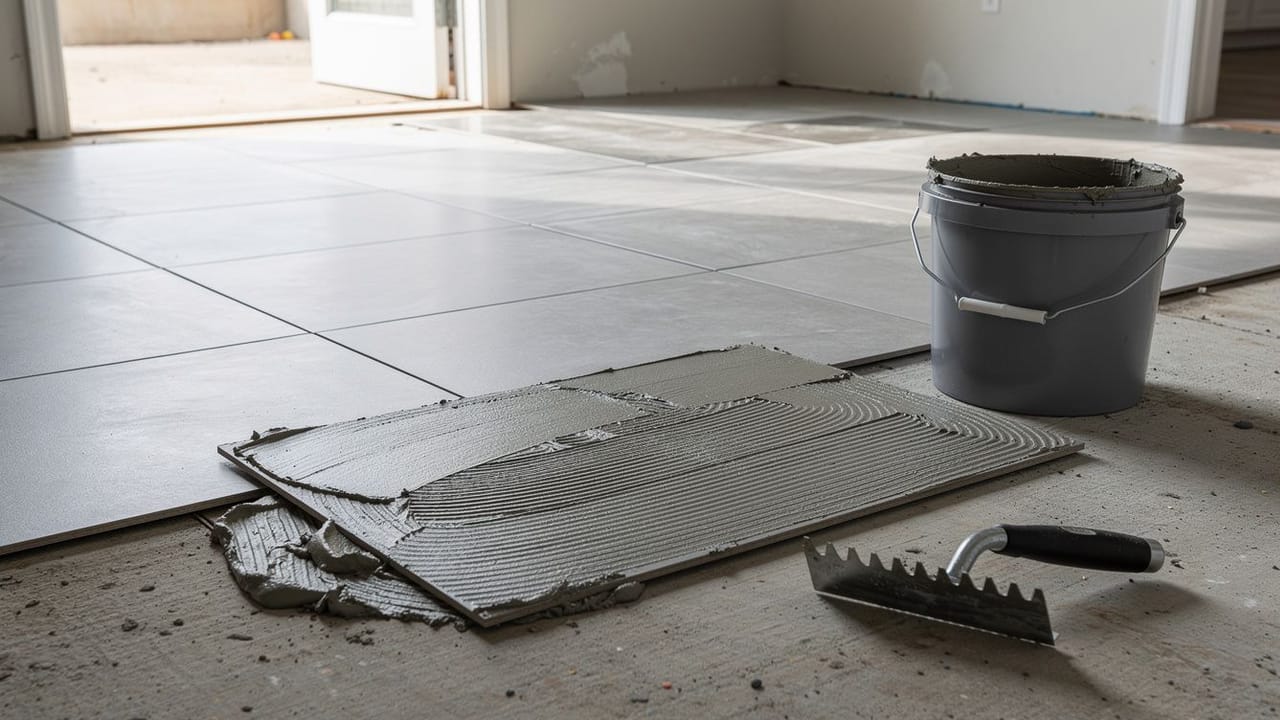
Those are the figures in ANSI A108.5, the installation standard for setting tile in thin-set. A Tile Magazine column by Scott Carothers, republished by Tile America, quotes the standard directly: no less than 80 percent contact, no less than 95 percent on exterior or interior wet installations, spread so that the corners and edges are fully supported. The same column quotes its minimum of 3/32 inch of mortar under the tile after it is embedded, and its rule that tile is never set into mortar that has skinned over.
In practice that sorts a house into two groups.
- At least 80 percent: a kitchen, hallway or living room floor tile job, a dry wall, a backsplash.
- At least 95 percent: a shower floor and walls, a tub surround, a covered porch, a patio, a pool deck or a set of outdoor steps.
- In both groups the corners and edges are bedded, because that is where an unsupported tile cracks first.
How we get the coverage, and what changes with thin porcelain
Coverage is checked, not assumed. CTASC recommends lifting freshly set tiles from time to time to see how much of the back is bonded, and that is how our setters work: comb the floor in straight lines, back-butter the tile, press it in and slide it across the ridges, then pull one up early and look. If the back shows bare stripes or dry corners, the trowel or the technique changes before the next row. On a porch in Middle Tennessee, where water gets under a tile and then freezes on a cold night, a 95 percent bed with nothing open under the edges matters more than anywhere else in the house, and porch and step tile before the first freeze goes through the rest of that job.
Gauged porcelain, the thin panels and slabs sold for walls and large floors, is its own category. Custom Building Products’ TB60 technical bulletin describes it as 3.5 to 6.5 mm thick, installed to ANSI A108.19 and the maker’s directions, with coverage required above 80 percent on interior walls, 85 percent on interior floors and 95 percent outdoors and in wet areas. It recommends only panels thicker than 5 mm on concrete floors and does not recommend bonding them directly to wood, and it calls for a substrate within 1/8 inch in 10 feet and 1/16 inch in 2 feet. A wood-framed floor in an older Nashville house gets a different plan before thin porcelain goes anywhere near it.
Size adds its own demands on top of all this: the bigger the tile, the flatter the floor has to be, which is the subject of why large format tile is harder. If you are pricing a porcelain floor, shower or porch, ask us for a free estimate and the written quote will name the mortar, the coverage we hold to for that room and what the floor needs first.
Sources
- Tile Council of North America, FAQ: Porcelain vs. Non-Porcelain — Porcelain defined as 0.5 percent water absorption or less; usually but not always frost resistant, check the manufacturer’s literature
- Custom Building Products, Large Format Tile FAQ — TCNA recommends mortars meeting ANSI A118.4, A118.15 and A118.11; polymer-modified mortar for porcelain; thin-set bed 3/32 to 3/16 inch, medium-bed up to 3/4 inch, shrinkage when applied thick
- Ceramic Tile and Stone Consultants, How to Achieve 95% Thin-set Mortar Contact — 80 percent contact for interior dry residential, 95 percent for wet, exterior and natural stone; no void over about 2 square inches; lift tiles to verify
- Tile America, republishing Tile Magazine (Scott Carothers), Why 95% Mortar Coverage is Necessary on Shower Walls — Quotes ANSI A108.5: 80 percent minimum contact, 95 percent exterior and interior wet, corners and edges supported; 3/32 inch minimum mortar after embedding; no skinned-over mortar
- Custom Building Products, TB60 Installing Gauged (Thin) Porcelain Tile, Panels and Slabs — Gauged porcelain 3.5 to 6.5 mm under ANSI A108.19; coverage over 80 percent interior walls, 85 percent interior floors, 95 percent exterior and wet; over 5 mm on concrete floors; not bonded directly to wood; flatness tolerances
FAQ
Porcelain Tile Installation: Mortar and Coverage — questions
What is the difference between porcelain and ceramic tile?
Water absorption. Porcelain is a dense tile that, by definition, absorbs 0.5 percent of its weight in water or less, while non-porcelain ceramic absorbs more than that. The look, size and price do not decide it. That density is why porcelain suits wet rooms and heavy traffic, and why it needs better mortar.
What thinset should be used for porcelain tile?
A mortar meeting ANSI A118.4 or A118.15, the second an improved-performance cement mortar, with A118.11 for plywood surfaces. Porcelain makers generally call for polymer-modified mortar over concrete, plywood and membranes. The standard is printed on the bag, and the tile maker’s installation sheet can ask for more.
Is porcelain tile harder to install than ceramic?
It is less forgiving. Porcelain draws almost no moisture from the mortar, so the bond depends on the right mortar and on how fully each tile is bedded. Setters back-butter, comb the floor, embed the tile and lift one early to check the back. Large sizes also need a flatter floor before any of it.
Can porcelain tile be installed outdoors?
Often, but check the tile first. Porcelain is usually frost resistant, though not always, so the manufacturer’s literature has to confirm it before it goes on a porch or patio. Outdoors the mortar has to cover at least 95 percent of each tile’s back, with no open voids under the corners and edges.
Can porcelain tile be used in a shower?
Yes, and it is one of the best tiles for one, because it absorbs so little water. A shower counts as a wet area, so at least 95 percent of each tile’s back has to be bonded in mortar, with the corners and edges supported. Tile is never set into mortar that has skinned over.